Water Softeners vs Demineralization (DM) Plants: Which System Does Your Industry Need?
Explore the differences in ion exchange resin chemistry, regeneration, and industrial applications between Water Softener and DM Plants.
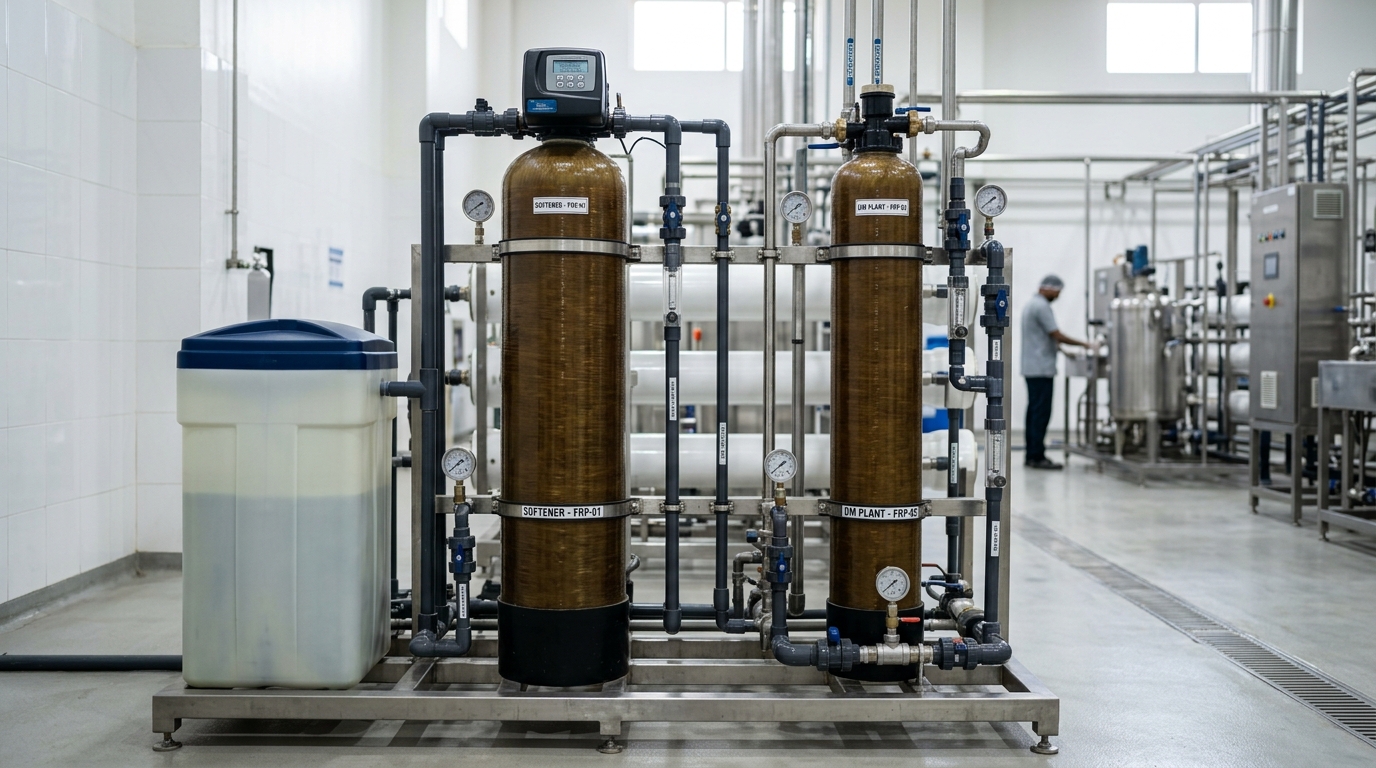
A common challenge for manufacturing facilities is determining whether their process requires a Water Softener Plant or a Demineralization (DM) Plant.
While both systems rely on ion exchange resins contained in FRP or Mild Steel (MS) pressure vessels, their chemical objectives and resulting water purity are distinctly different.
At Aqua Shakti Industries, we manufacture both manual and semi-automatic ion exchange units designed for industrial, pharmaceutical, and institutional usage.
1. Water Softener Plant: Eliminating Hardness
A water softener specifically targets calcium ($Ca^{2+}$) and magnesium ($Mg^{2+}$) ions—the minerals responsible for pipe scaling, boiler tube failure, cooling tower fouling, and reduced detergent efficiency.
How it Works:
- Raw hard water flows through a bed of Strong Acid Cation (SAC) resin in sodium form ($Na^+$).
- Calcium and magnesium ions have a higher electrical affinity for the resin active sites than sodium.
- The resin captures $Ca^{2+}$ and $Mg^{2+}$ ions and releases harmless sodium ions ($Na^+$) in stoichiometric exchange:
$$2\text{R-Na} + \text{Ca}^{2+} \longrightarrow \text{R}_2\text{Ca} + 2\text{Na}^+$$
Regeneration:
When the resin becomes saturated with hardness ions, it is regenerated using a concentrated brine solution (common salt – $\text{NaCl}$ 10–15%). Sodium flushes out the calcium and magnesium to drain, restoring the bed to full capacity.
Key Output Characteristics:
- Total Hardness: $< 5\text{ ppm (as }\text{CaCO}_3\text{)}$
- TDS (Total Dissolved Solids): Remains virtually unchanged (minerals are simply replaced with sodium salts).
- Conductivity: Stays approximately the same as raw water.
Typical Applications:
- Low to Medium Pressure Boiler Feed
- Cooling Towers and Heat Exchangers
- Textile Dyeing and Washing Facilities
- Hotels, Commercial Laundries, and Hospitals
- Housing Societies and Swimming Pools
2. Demineralization (DM) Plant: Total Mineral Removal
When an industry requires ultra-pure water with zero dissolved minerals, minimal conductivity, and chloride-free purity, a water softener is insufficient. A Demineralization (DM) Plant is required.
Two-Bed DM Plant Architecture:
[Raw Water] ──> [Cation Exchanger (H+ Form)] ──> [Degasser Tower (CO2 Removal)]
──> [Anion Exchanger (OH- Form)] ──> [Deionized Pure Water Tank]- Strong Acid Cation (SAC) Column: Contains cation resin regenerated with Hydrochloric Acid ($HCl$). All metallic cations ($Ca^{2+}, Mg^{2+}, Na^+, K^+$) are exchanged for Hydrogen ions ($H^+$), creating dilute mineral acids.
- Degasser Tower: Strips dissolved carbon dioxide ($CO_2$) gas generated from bicarbonate alkalinity, reducing load on the downstream anion column.
- Strong Base Anion (SBA) Column: Contains anion resin regenerated with Caustic Soda ($NaOH$). All acid anions ($Cl^-, SO_4^{2-}, NO_3^-, SiO_3^{2-}$) are exchanged for Hydroxyl ions ($OH^-$).
- Water Neutralization: $H^+ + OH^- \longrightarrow H_2O$ (pure water).
Key Output Characteristics:
- Conductivity: $< 10\text{ }\mu\text{S/cm}$ (or $< 30\text{ }\mu\text{S/cm}$ depending on feed)
- TDS: $< 5\text{ ppm}$
- pH: Neutral ($6.8 - 7.5$)
- Chloride & Silica: Trace or non-detectable
3. Mix Bed (MB) Polishing Plant
For specialized applications such as high-pressure power boilers, electronics manufacturing, or injectable pharmaceutical grade water, a Mix Bed Plant is placed after the two-bed DM system or RO permeate stream.
The Mix Bed combines both Cation ($H^+$) and Anion ($OH^-$) resins thoroughly mixed in a single column. It performs thousands of repeated demineralization stages in a single pass.
Aqua Shakti Mix Bed Standard Range:
| Model | Maximum Flow Rate (L/hr) | Working Pressure (Max / Min kg/cm²) | Resin Qty (Liters) | Output Between Regens (at 100 ppm TDS) |
|---|---|---|---|---|
| D.M 100 | 1,000 L/hr | 2.0 / 0.8 | 100 L | 3,500 L |
| D.M 200 | 2,000 L/hr | 2.0 / 0.8 | 200 L | 7,000 L |
| D.M 600 | 6,000 L/hr | 2.0 / 0.8 | 300 L | 10,500 L |
| D.M 800 | 8,000 L/hr | 2.0 / 0.8 | 400 L | 17,500 L |
Output Conductivity: $< 0.5\text{ }\mu\text{S/cm}$, Silica $< 0.02\text{ ppm}$.
Summary Selection Rule of Thumb
- Choose a Water Softener if: Your main concern is scaling in heat transfer equipment, boilers $< 300\text{ PSI}$, cooling towers, or textile processing where total TDS is not critical.
- Choose a DM / Mix Bed Plant if: You are formulating chemicals, manufacturing batteries, plating metals, running high-pressure steam turbines, or manufacturing pharmaceuticals where total ionic purity is mandatory.
Talk to an Aqua Shakti water treatment engineer today to review your raw water test report and receive customized system drawings.
Need Technical Sizing or Plant Quotation?
Consult directly with our water treatment engineers for customized Reverse Osmosis, Softeners, DM Units, or ZLD wastewater treatment skids.
Technical Note: Water Quality Standards Reference+
All plant sizing guides reference BIS 10500 drinking water parameters, Central Pollution Control Board (CPCB) discharge limits, and Gujarat Pollution Control Board (GPCB) norms for industrial effluent discharge and reuse standards.