ETP vs STP: Understanding Industrial Effluent vs Sewage Wastewater Treatment
A comprehensive technical comparison of Effluent Treatment Plants (ETP) and Sewage Treatment Plants (STP), discharge norms, and design considerations.
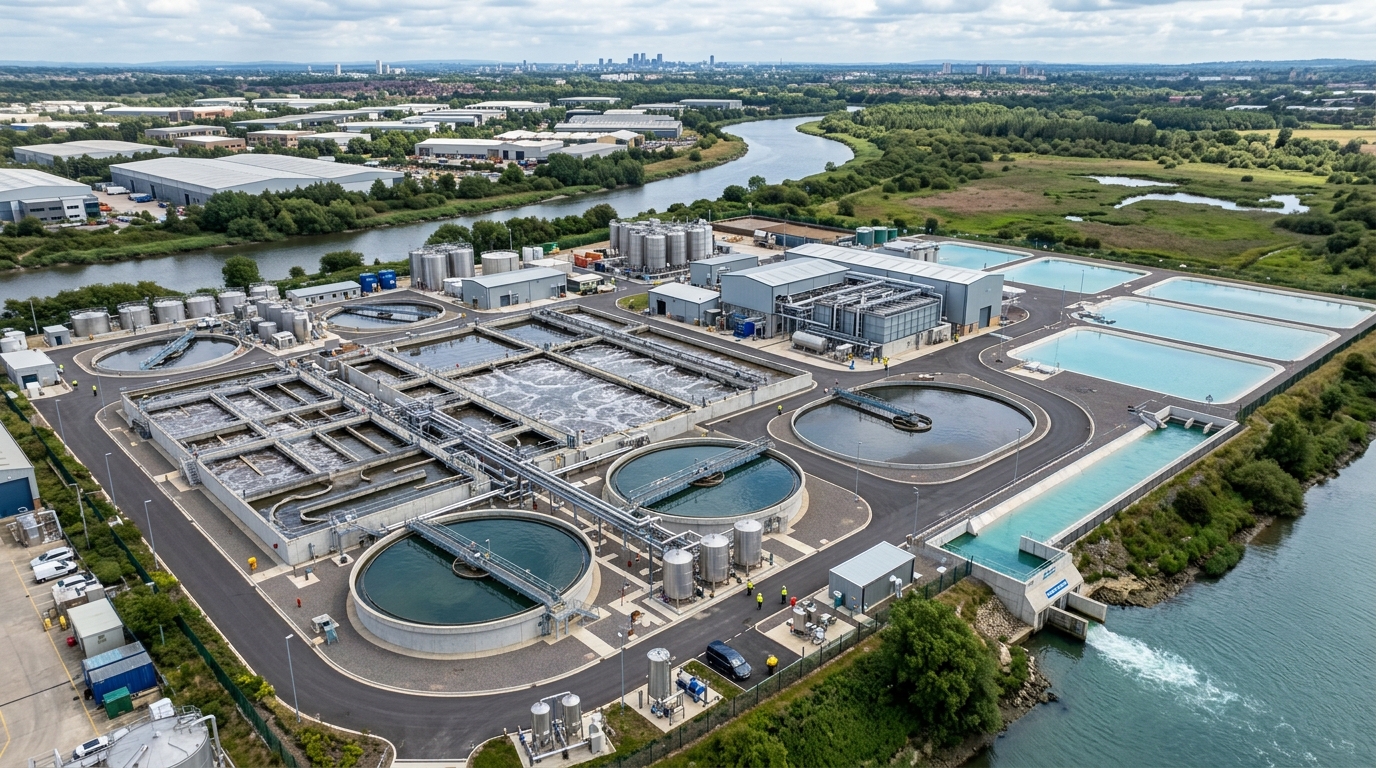
With stringent environmental regulations enforced by the State Pollution Control Boards (SPCBs) and Central Pollution Control Board (CPCB) in India, managing wastewater has evolved from a statutory formality into a vital operational necessity.
Industrial estate hubs such as Vapi, Ankleshwar, Dahej, and Sanand rely heavily on customized Effluent Treatment Plants (ETP) and Sewage Treatment Plants (STP).
While both systems purify wastewater before discharge or recycling, their inlet wastewater characteristics, treatment processes, and engineering configurations differ significantly.
What is an STP (Sewage Treatment Plant)?
An STP processes domestic wastewater generated from toilets, kitchens, bathrooms, canteens, and laundry in residential apartments, hotels, schools, universities, hospitals, and corporate parks.
Domestic sewage is characterized primarily by organic contaminants, pathogenic bacteria, soaps, and suspended solids:
- BOD (Biochemical Oxygen Demand): Typically 250 – 400 mg/L
- COD (Chemical Oxygen Demand): Typically 400 – 600 mg/L
- Total Suspended Solids (TSS): 200 – 400 mg/L
- Fecal Coliform Count: High
Aqua Shakti “DELTA” PR Sewage Treatment Plant
The Aqua Shakti DELTA PR STP is a fully biological biological treatment plant compliant with international standards including Marpol 73/78 Annex IV, European Maritime Equipment Council, and USCG regulations.
Key Process Stages:
- Screen Chamber & Grit Trap: Removes plastic wrappers, rags, and coarse gritty particles.
- Primary Clarifier: Settles heavy organic solids as primary sludge.
- Aeration Basin (Activated Sludge / MBBR / SBR): Microorganisms digest dissolved organic pollutants under continuous dissolved oxygen aeration supplied by positive displacement air blowers.
- Secondary Clarifier / Tube Settler: Separates clarified water from microbial biomass.
- Tertiary Treatment (Sand & Carbon Filtration + Chlorination / UV): Disinfects the effluent, rendering it crystal clear and odorless.
Guaranteed Effluent Output Quality:
- Suspended Solids (TSS): $< 50\text{ mg/L}$
- $\text{BOD}_5$ (at 20°C): $< 50\text{ mg/L}$ (and $< 10\text{ mg/L}$ with tertiary polishing)
- Coliform Bacteria: $< 200 / 100\text{ ml}$
Treated STP water is reused on-site for garden landscaping, HVAC cooling tower makeup, toilet flushing, and floor washing.
What is an ETP (Effluent Treatment Plant)?
Unlike domestic sewage, industrial effluent contains complex chemical contaminants generated by manufacturing activities in chemical synthesis, pharmaceuticals, electroplating, textiles, dyeing, paper, and food processing plants.
Industrial wastewater can have:
- Extreme pH values ($< 3$ or $> 11$)
- Very high COD ($1,500$ to $50,000+\text{ mg/L}$)
- Toxic heavy metals (Chromium, Nickel, Zinc, Lead)
- High salinity (TDS $> 10,000\text{ ppm}$)
- Refractory organic compounds and non-biodegradable surfactants
ETP Treatment Unit Operations:
- Screening & Oil/Grease Trap: Traps floating oils and scum.
- Equalization Tank with Air Grid: Homogenizes flow fluctuations and temperature surges.
- Coagulation & Flocculation (Flash Mixer + Clariflocculator): Dosing PAC (Poly Aluminium Chloride), Alum, and Polyelectrolytes to neutralize colloids and form settleable flocs.
- Physico-Chemical Settling: Clarifier removes chemical sludge.
- Biological Treatment (Aerobic / Anaerobic UASB): For biodegradable organic fractions.
- Sludge Dewatering (Filter Press / Decanter Centrifuge): Compresses sludge cake for authorized hazardous waste disposal (CHWTSDF).
ETP vs STP: Direct Feature Comparison
| Parameter | STP (Sewage Treatment Plant) | ETP (Effluent Treatment Plant) |
|---|---|---|
| Inlet Source | Residential, domestic, canteen, hotels | Industrial manufacturing, chemicals, pharma |
| Primary Mechanism | Biological digestion (Aerobic/Anaerobic) | Physico-chemical coagulation + Biological |
| BOD:COD Ratio | High ($> 0.5$) – easily biodegradable | Low ($< 0.3$) – resistant to simple biology |
| Chemical Dosing | Minimal (coagulant aid, chlorine) | Heavy (Alum, Lime, PAC, Polymers, Antifoam) |
| Sludge Type | Organic bio-sludge (useful as fertilizer) | Hazardous chemical sludge (requires disposal) |
| Footprint | Compact modular package plants | Multi-stage civil / skid configurations |
Aqua Shakti Benefits & Scope of Supply
When you partner with Aqua Shakti Industries for your ETP or STP installation, you receive:
- Compact Footprint: High-rate clarification and MBBR media maximize capacity in limited space.
- Fast Process Recovery: Resilient biomass formulation recovers quickly from seasonal or process upsets.
- Turnkey Equipment: Including Skid-mounted tanks, Sludge filter press, Air blowers, Dosing pumps, and automated electrical control panels.
- Full Regulatory Compliance: Meets strict GPCB, CPCB, and Marpol discharge norms.
Consult our engineering team in Vapi for plant upgrades, capacity revamping, or new greenfield wastewater treatment projects.
Need Technical Sizing or Plant Quotation?
Consult directly with our water treatment engineers for customized Reverse Osmosis, Softeners, DM Units, or ZLD wastewater treatment skids.
Technical Note: Water Quality Standards Reference+
All plant sizing guides reference BIS 10500 drinking water parameters, Central Pollution Control Board (CPCB) discharge limits, and Gujarat Pollution Control Board (GPCB) norms for industrial effluent discharge and reuse standards.